
(or Love’s Labours Lost)
Sitting on the wire of the roughest/toughest area of town, our school was definitely not what you’d call tennissy, though our maths teacher, Mr. Albert Taylor, was a Wimbledon umpire and he accidentally brought the game of tennis to our attention in a big way.
In the days of Martina Navratilova’s reign at the Croquet Club, she once accused Mr. Taylor of favouring her opponent, Britain’s Sue Barker, with line calls (he was no cheat, so most likely he’d fallen asleep).
‘Tigger Taylor loves Sue Barker’ was scrawled across school blackboards on the day the story hit the back pages of the tabloids, and Old Albert endured years of merciless teasing from pupils – he couldn’t walk a corridor or into a classroom without cries of ‘out!’ or a McEnroe-type ‘you cannot be serious’ rant.
Mr. Taylor seemed embarrassed that he’d been blessed with a good heart, though he failed to conceal his caring nature from astute, street-wise pupils. He often brought a bag of match balls back from tennis tournaments for us, and he got me my first tickets to the Croquet Club Championships.

‘Tigger’ never gave up nourishing a love of tennis in his pupils and he arranged annual visits to tournaments in Nottingham and at the Northern Lawn Tennis Club in Manchester.
It was the view of our ‘gang’ that tennis was a game for wimps, and we only joined the trip to The Northern’s grass court tournament to get out of lessons: if we hadn’t been thrown out of the hospitality tent (for helping ourselves to the optics), that myth might never have been exploded, by an American with a metal racket and a dodgy basin-cut: – one Jimmy Scott Connors.
How I ended up coaching is a longer story, but it soon became a passion and I taught tennis for the best part of two decades. And whilst I could’ve made more money working at McDonalds (part time), a lack of riches has always seemed a fair trade off for doing something I enjoy.
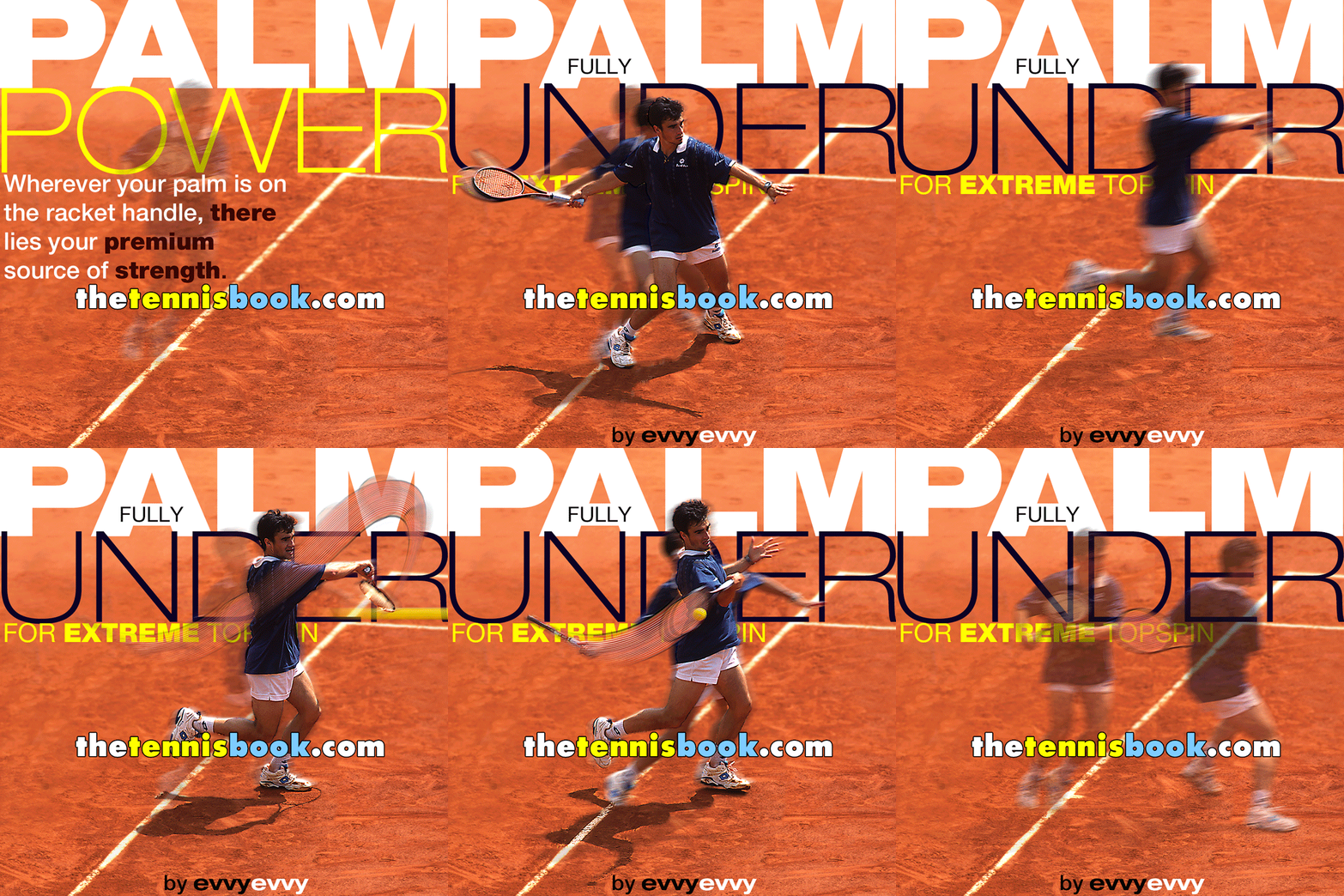
The more serious I became about teaching tennis, the less happy I was with the narrowness of the accepted tennis coaching manual, which at the time bore little resemblance to the individuality the top players exhibited on court.
I asked a friend, who taught English at a Paris University, to get tickets for the French Open and in 1987 I first took my cameras to Roland Garros.
A year later I was an accredited photographer at Roland Garros. In 1990 (or thereabouts) I sold a series of instruction articles to the official Women’s Tennis Association magazine ‘Inside Women’s Tennis’ and from 1990 thru 1993 I was stroke analyst for the (then) top German magazine Tennis Revue under the excellent editorship of Dieter Schön.


Pardon the puffery, but for Germans to give an Englishman free technical rein, over three and four page spreads, means you’re getting something right, especially as I was also analyzing the technique of their best ever players – Graf, Becker, Stich etc..
And back in good old Blighty?
The British pyramid model dictated that I justify and sustain somebody’s salary further up the sporting food chain, by ‘feeding’ my best kids to some apparatchik – someone who wouldn’t plaster their criticism of ‘the system’ over pretty much a full page of The Times sports section (provided by the then sports editor Tom Clarke).
The insurmountable problem with many/most (all?) sporting associations is, as always, linked to the nature of power, and – like any corporate pyramid model – the intrinsic need to control what happens at the bottom so those at the top get to perpetuate their well-salaried existence.

People genuinely passionate about sporting opportunity rarely get to where big decisions are made and budgets meted out, because they are out-flanked by professional risers… because rising to the well-paid top is their well-heeled, well-schooled, well-connected raison d’etre.
And if one escapes the net and rocks the boat?
Silence by Salary usually kicks in when they’re absorbed into the status quo, when telling it as-is can be expensive.
It is from such mediocre and self-serving materials that governing bodies have forever been shaped (re-shaped and honed) into Politburos, which – by design and in spirit – draw everything in to a sticky central web of control.
For shameless colonisers who gravitate towards money, career and influence – and who are bedded in like Japanese knotweed wherever ‘funding’ is to be got – this pyramid scheme is the right way up and must be baricaded in at all costs.
But for the opposing principles of education and opportunity for all, the pyramid is upside down and nothing less than a self-perpetuating curse on sporting opportunity for the many.
At the height of my obsession with tennis, I went around the primary schools of my hometown (and-beyond) with a bagful of rackets, giving demonstrations of short tennis and tennis: more a pantomime (‘Oh no he didn’t… oh yes he did!‘) to whet the appetite, than the curriculum seriousness which sucks the joyous heart out of much good teaching.
The demos were free and I hadn’t learned how to drive a car, so I went everywhere on the bus with an A-to-Z in my pocket – at a peak, I was giving free tennis demonstrations to over 200 schools in a year.
I should emphasise that it was no hardship, and these demos had the ultimate aim of getting kids interested enough to pester mummy and daddy to fork out money for a (albeit inexpensive) course. The take-up was minuscule so I got friends who worked in offices to do my photocopying for free – when you are giving out 200 letters per school your costs soon mount up.
Consequently the demonstrations cost little more than my time and visiting schools was always a source of joy: if the sound of children’s laughter doesn’t raise your soul up to the heights of humanity, you are seriously in need of help.

We all have good and bad days, and the one I now hold before my mind’s eye turned out to be both. Making my way from one school to the next, I got lost in a maze of council houses. I knew the area of Bolton vaguely, as one of my first girlfriends grew up on the estate, and it was (and still is) the poorest estate for many miles – I’ve seen mothers leave the pub in their PJs, to pick their children up from school with a pint of beer in their hand, though the pub is long gone and heroin now shreds what remains of community fabric.
Anyhow, there I was with a bag of twenty mini tennis rackets on my shoulder and knowing full well there was no business to be had on that estate. I looked at my watch. I was already five minutes late and whilst preparing excuses in my head, a bus came round the corner, so I jumped on board.
I didn’t feel too good about myself, but this thought eased my guilt: ‘they probably don’t even remember I’m coming’ (which wasn’t unknown).
The minute I returned home, the phone rang – It was the school.
‘Why aren’t you here?‘ demanded the Head. ‘All the children are sat in assembly hall waiting for you.’
I was disgusted with myself.
‘I couldn’t find the school,’ I croaked, which wasn’t a complete lie – I just hadn’t looked too hard!
As penance, I ordered a taxi and went back (poetically, this took a large chunk out of my last ten pound note, which was all I had to last me the week).

Every town and city has its poor areas and too often it is the children who pay a price; for the unfortunate circumstances of their parents, perhaps, or those plain bad choices from which no adult life is exempt.
When you’ve been out-and-about in the world, there are things you cannot help but see. Experience is a double-edged sword, which affords you glimpses into the lives of those around you, and the future I saw in those eager faces was not bright.
I got to know some fabulous teachers down the years and over future visits I came to understand that the Head had the best qualities of the old school. To him, teaching was a vocation – THE vocation – and he determined to ensure that whatever problems those children had (those he could not overcome for them), were left at the door when they entered his school.
By way of recompense for my previous selfishness, I stayed all afternoon. Every child got to join in a game of some sort and I also took photographic prints of Andre Agassi, which I gave out as prizes.
I asked the Head what would happen if we gave some of the kids a free course?
‘Nothing‘, he answered brutally.
Most parents wouldn’t bring them and the ones who could be bothered, couldn’t afford the bus fare. He gave it some thought, went to have a chat with one of his teachers and decided that he would drive back after dinner (he lived miles away), pick the kids up at their home and drop them off at the sports hall for the 7pm class and one of his teachers agreed to collect them after the session and take them back home. We chose the two most able: one seven years old and the other eight.

When they arrived for their first session, 15 to 20 other kids were already involved in short tennis games and drills. The two children edged nervously into the sports hall behind their Head. Dressed in miss-matched hand-me-downs, they were clearly intimidated but as soon as I got them hitting balls they were transformed.
Beyond the marketing, gambling epidemics and orchestrated idolatry, the simple act of playing sport still has the capacity to shatter barriers, especially amongst kids.
The one thing I miss about not coaching any more is the laughter and exhilaration that sport fosters, and the essential (and natural) sense of community.
In the days before the plush Bolton Arena Tennis Center, I hired sports centres and school halls (in varying degrees of disrepair) all over the town, and started kids from the age of four or five on short tennis courses.
When they progressed to the bigger game I had two ball machines running non-stop and an enjoyable little system, and older, more experienced players would gladly come along to short tennis sessions to rally with little ones.
The two kids came for a couple of courses, but from the start the Head had warned that one of them had changed school four times in the past couple of years – the mother was prone to swap boyfriends and move house and district at short notice, and this is precisely what happened.
And the other child?
I admit with regret that I cannot remember.
Could they have been champions?
What I know now, which – in my wilful stupidity and blind zeal – I didn’t grasp then, is that it truly doesn’t matter.
Although it ticks all the clichéd boxes and pads out many a news channel feature, particularly when the annual Croquet Club gravy train hits town, the myopic ‘search for a tennis champion’ will always be a pointless cul-de-sac, because it focuses narrowly on the few to the exclusion of the many.
This is just one blight on the conveyor belt that manufactures sports people from the cradle (often at the expense of a childhood), loads initial success up with sponsorship deals (often at the expense of their freedom to express), surrounds them with a ‘team’ on the payroll (often at the expense of reality – who’s going to challenge the golden cash-cow?). Is it really any wonder some top players start to crack inside the ill-fitting straightjacket they’ve been sewn into?
And because the pro game properly rewards only a few players outside the world’s top 100 – they certainly earn nothing like an English Championship footballer, who wouldn’t get in the world’s top 5,000 – many gifted racketeers tire of traipsing round a lesser circuit in the soul-destroying pursuit of ranking points, and take up jobs coaching the next generation of potential empty dreamers, which keeps the merry-go-round turning and a healthy, cost-effective alternative as distant as the sun.
In contrast to this expensive pyramid production line, enjoyment and the health benefits of sport, especially for children, is something that can be had by anyone with a full belly.
Sport is (or at least should be) bigger than personal gain, advertising, Management Groups, corporate sponsorship, pay-per-view and ratings figures.
Above and beyond Caesar’s Currency and ego fuel, it can brighten the dullest day and put smiles on the most sullen faces.
Also, it is arguably the best antidote to the difficult years; a healthy alternative to the street corner, and, whilst chasing a tennis ball might not unearth the meaning of life or cure a bruised and battered heart, it certainly beats beating up a granny and chasing down your next rock or bag of brown.

Some weeks before what turned out to be my final visit to the previously mentioned school, I was playing a pool match for my local pub in the town’s Labour Club (remember those?), when a woman asked if I wanted to buy a ticket for the raffle.
I asked her what the prize was?
‘A teddy bear’she replied, ‘a BIG teddy bear’.
In that case no, I didn’t want a ticket, because I didn’t fancy wobbling home after a few beers with a five-foot high teddy bear under my arm. The bolshy ticket-seller wouldn’t take no for an answer, so I bought a ticket just to shut her up…but only one.
No prize for guessing who won. When I reluctantly stood up to collect my prize, the ticket seller told the man with the microphone about my reluctance to buy into the raffle and everyone heard his distinctly old Labour response over the PA system:
‘You mean to say the tight-fisted bastard only bought one ticket?’
Anyhow, I stuffed teddy into my largest bag on my next trip to the same school. Come the end of the session, when all the kids had gone back to class, I asked the teacher to send for a child from reception class, who had hit the balls particularly well: pointless giving her a free tennis course, as by this time the old Head had retired and there was nobody else willing to take up a lost cause. When I handed her the teddy, she became agitated and upset: as if this was some cruel joke, and I was waiting for her to take hold of the teddy before snatching it back.


God only knows what turmoil lay within that tiny heart and mind, and when she gently took hold of the teddy she started sobbing.
At about this time I sat down at my word processor and wrote a raging multi-part TV drama (you know, like you do…!). The inspiration was drawn equally from teachers like Tigger Taylor and the Primary School Head, and all those kids who, at the very least, deserve equal footing.

Set to thumping soul and house music, the underlying story was the rise of a group of youngsters, each one of which has been failed by the adults in their life.
They begin to bind as a group when they discover the child of a local heroin addict is a natural tennis player (bet the Croquet Club would love that – any chance of a free membership from The Committee to get them through detox?) – the youngster becomes their mascot and, under the guidance of their teacher, they soar above institutional snobbery and the cold hand of fate.

Every television and production company dismissed the script, except for film maker Ken Loach. The Director of Kes, The Wind that Rocks the Barley and Looking for Eric wrote to say he thought it was a wonderful story and that they’d all read the script in the Parallax Pictures (now 21 Films) office.
He had time and resources to do only one film every couple of years, but said he’d see what he could do. Despite his generosity, which included personal efforts to get my work represented by the UK branch of the William Morris Agency, it never got before a lens – and it grows in style and relevance with each passing year.

When I set out with a bag full of rackets and my A-to-Z, I had such great hopes and a virtually unbreakable enthusiasm (we Papistes are prone to a futile Crusade!), yet in the end I achieved embarrassingly little. For years I did have an extended family, who are now all adults, and I regularly speak to – and meet up with – those ex-pupils who formed the core of regulars.
At the zenith of my flawed sporting mission, I called in on a tennis-playing acquaintance, who worked at Salford’s Sports Development offices, which were then situated on The Crescent in the impressive old fire station block. Like Albert Taylor, he too was a Wimbledon umpire and a teacher, and I’d gone to see if we could develop some kind of project between us?
‘What’s your ultimate goal?’ he asked and my response needed no thought.
‘To take tennis into places like Hulme and Mosside.’
He looked at me with a mixture of horror and concern – was I in my right mind? (I get that a lot!).

‘Well that sounds like a labour of love!’ was all he could contribute and he sure-as-hell wasn’t going with me.
I suppose A Labour of Love is a good description of my tennis coaching years. But for that particular love’s labours to yeild a worthwhile harvest, I needed more than bus tickets and an A-to-Z.
 evvy evvy
You must be logged in to post a comment.